

When Injury Challenges Your Identity as an Athlete — And How to Reclaim It

If you’ve ever been injured and caught yourself thinking, “If I can’t train like I used to… am I still an athlete?” you’re not alone.
For competitive athletes and fitness-driven adults, injury is rarely just physical. An ACL tear. A knee or hip issue that keeps resurfacing. Chronic low back pain that flares up just as training starts to feel good again. These setbacks don’t only interrupt workouts. They can challenge confidence, identity, and a sense of control.
Research on athletic identity and sports injury suggests that injury can affect how athletes see themselves, particularly when physical limitations, time away from sport, and uncertainty about returning to previous levels of performance disrupt an important part of their self-concept. [1]
At Trifecta Therapeutics, we see this most often in athletes navigating transitions: graduating from college, entering the workforce, becoming a partner or parent, or taking on new responsibilities that limit time and energy. The structure that once supported training disappears. Injury adds friction. Staying athletic suddenly feels harder than it ever did before.
This isn’t a failure of discipline or motivation; It’s a normal response to change.
Why Athletic Identity Still Matters After Competitive Sports
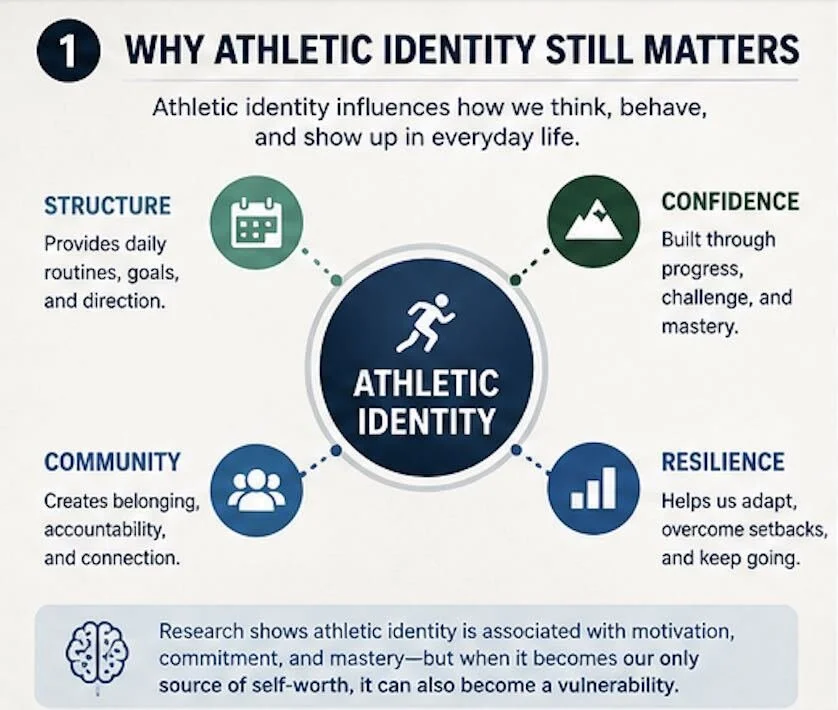
Athletic identity refers to the degree to which someone identifies with the athlete role. For many people, that identity becomes an important part of how they understand themselves, organize their time, and approach challenges. [1,2]
Research suggests that athletic identity can influence how people engage with sport, motivation, and their sense of themselves as athletes. A large systematic review and meta-analysis examining 101 studies and more than 20,000 athletes found that stronger athletic identity was associated with sport-related characteristics such as intrinsic motivation, commitment, and mastery-oriented goals. At the same time, the relationships with negative psychological or behavioral factors were generally smaller and more complicated than the idea that “strong athletic identity is bad.” [2] That distinction matters.
Athletic identity isn’t inherently a problem.
For many athletes, it is a source of motivation, community, competence, and purpose. The challenge comes when the athlete role becomes the only meaningful source of self-worth.
When organized sports end, many adults unintentionally let that identity fade. The result may not simply be less training. It can also mean losing some of the routines, community, confidence, and sense of physical capability that came with being an athlete.
Being an athlete isn’t about playing a sport forever.
It’s about how you approach challenges, effort, and adaptation.
How Injury Challenges Identity
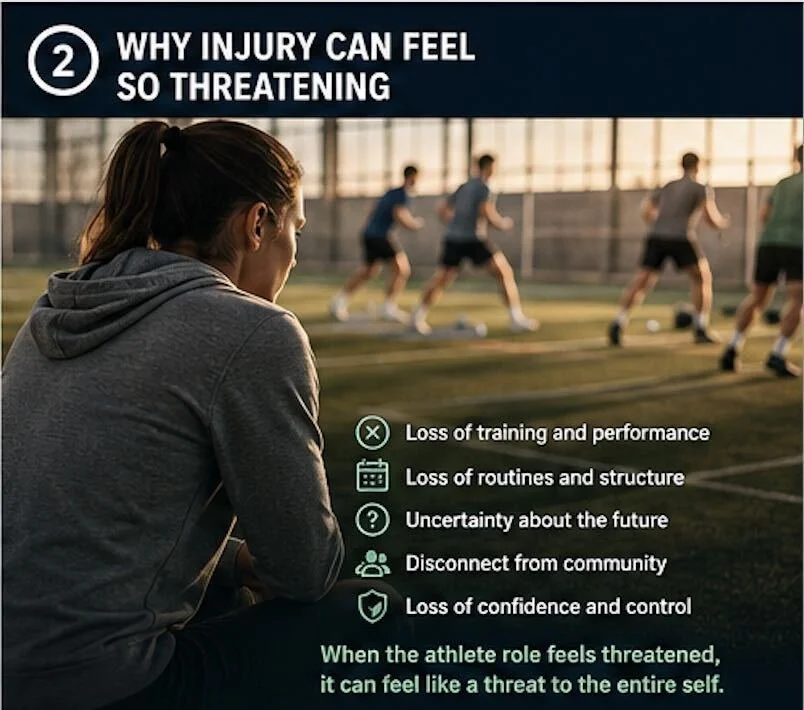
Injury removes access to familiar outlets for stress relief, confidence, and control. Training looks different. Performance drops. Progress feels slower than expected.
For some athletes, this can contribute to what researchers describe as athletic identity foreclosure: a strong commitment to the athlete role without enough exploration of other roles, interests, or sources of identity. [3]
This is especially relevant during life transitions, such as:
Former college athletes entering full-time careers
Young adults balancing work, relationships, and family
New parents or caregivers with limited time and energy
Athletes whose sport or competitive career is coming to an end
Without the external structure sport once provided, injury can magnify uncertainty.
That doesn’t mean you’re mentally weak.
It means the system you relied on changed.
When Sport Ends, the Identity Doesn’t — But the Structure Does
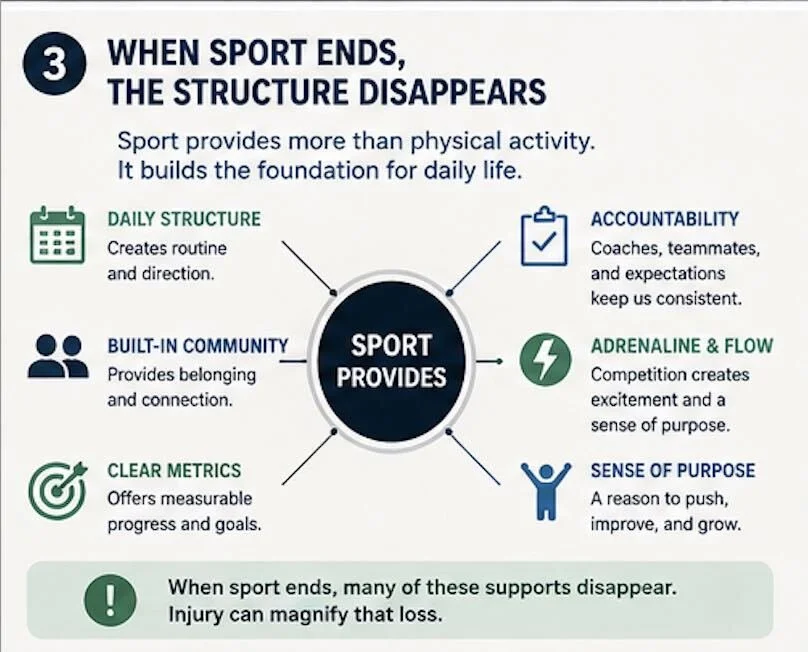
For many post-college athletes, the hardest transition isn’t injury. It’s the loss of sport itself.
Sport provides:
Daily structure
External accountability
Built-in community
A steady rush of adrenaline
Clear metrics for success
What sport doesn’t always teach is how to live without those things. When that structure disappears, athletes may search for control elsewhere. That can show up as:
Over-exercising to feel normal again
Training through pain or injury
Rigid or restrictive eating behaviors
Anxiety around rest days
Guilt when workouts don’t feel “hard enough”
For some athletes, these behaviors can represent attempts to regain structure, control, or a familiar sense of self during a period of uncertainty. Research has linked stronger athletic identity with behaviors and attitudes such as playing through pain and rehabilitation overadherence, although these relationships are complex and do not mean that every athlete with a strong athletic identity will develop these behaviors. [4]
These behaviors aren’t necessarily signs of weakness. They can be attempts to cope during a period of identity uncertainty. Learning how to live without constant adrenaline and external structure is a skill. Like any skill, it can be learned — but it takes time. The internal struggle is real, and it deserves to be acknowledged.
Injury Doesn’t Take Away Your Identity — It Refines It
One question we often ask in the clinic is simple:
How can we turn this setback into a stronger comeback?
Your identity as an athlete doesn’t come from what you can lift, run, or compete in.
It comes from values:
Effort
Consistency
Ownership
Adaptability
Research also reminds us that athletes don’t all respond to injury in the same way. Longitudinal research following people through ACL reconstruction has found significant changes in athletic identity over time, but individual responses vary. Some athletes decrease their identification with the athlete role, while others remain relatively stable or increase their identification. [5,6] That variability matters and is within your control.
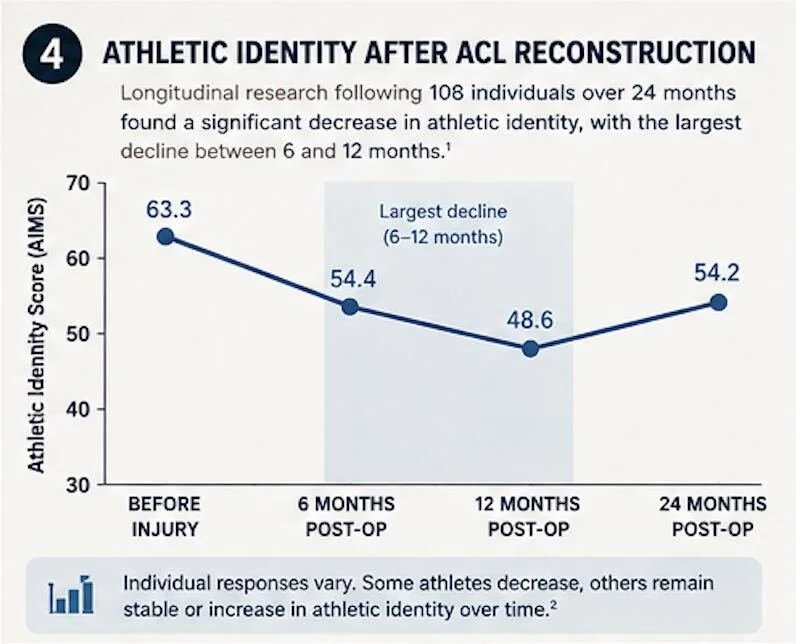
Injury can challenge your athletic identity, but it doesn’t dictate what that identity ultimately becomes.
Injury forces clarity:
What is within your control?
What isn’t?
Where should your energy actually go?
When you focus on what you can control and let go of what you can’t, setbacks stop feeling like proof that something is wrong with you.
They become opportunities to build a more durable version of yourself.
Remembering Your “Why” Changes the “How”
Most people didn’t fall in love with training just to win.
They trained because it:
Helped manage stress
Built confidence
Created structure
Provided community
Made them feel capable in their body
That’s the why.
Injury often disrupts how you train, but reconnecting with why movement matters allows flexibility in what you do.
If competition isn’t realistic, mastery still is.
If high volume isn’t possible, consistency still matters.
If time is limited, intention becomes the win.
The goal isn’t necessarily to preserve every part of your old training routine.
It’s to preserve the underlying values that made movement meaningful in the first place.
Rehab and Transition Are Where New Skills Are Built
Injury rehab and post-sport transitions share something important.
They force athletes to develop skills sport never required.
These include:
Internal motivation instead of external pressure
Emotional regulation without movement as the only outlet
Flexible definitions of success
Self-trust without constant validation
Patience when progress is slower than expected
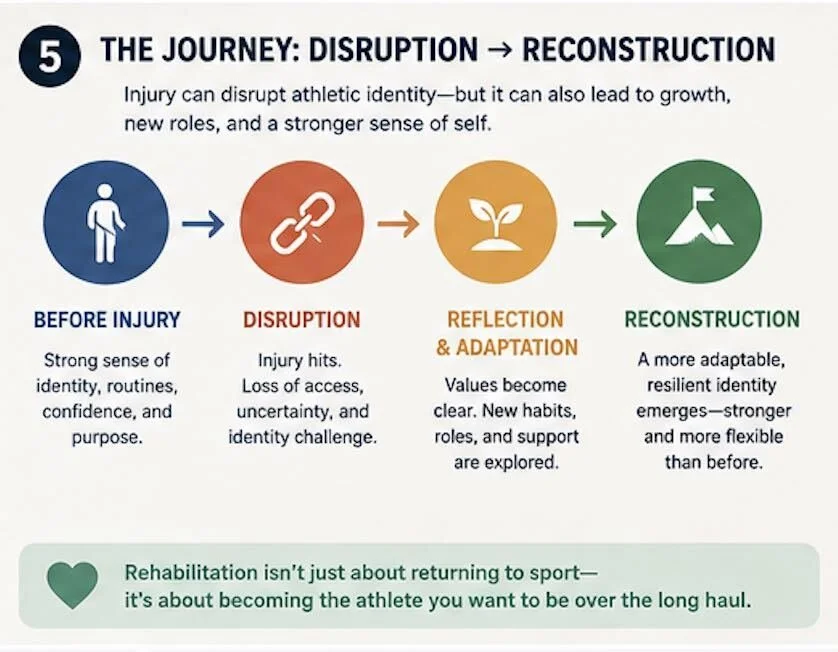
Recent research supports the idea that rehabilitation can involve identity reconstruction, not simply physical recovery. A 2025 systematic review of 24 qualitative studies identified two major themes in athletes recovering from sports injuries: athletic identity disruption and athletic identity reconstruction. Some athletes experienced a diminished sense of athletic identity, while others rebuilt that identity through alternative roles, new activities, or different ways of participating in sport. [1]
This phase is uncomfortable, especially for athletes used to pushing and overriding signals from their body.
But discomfort here doesn’t necessarily mean regression.
It can mean growth.
Rehab isn’t just physical restoration. It’s identity expansion.
Practical Ways to Stay Athletic Without Losing Yourself
Staying athletic long-term often requires redefining what training means.
Training doesn’t have to equal exhaustion.
It can mean building capacity, respecting limits, and working with your body instead of against it.
The goal isn’t to stop being an athlete.
It’s to make athleticism flexible enough to survive changes in injury, schedule, age, and priorities.
Helpful reframes include:
Anchoring goals to consistency, energy levels, sleep quality, and mental clarity rather than appearance or numbers
Creating structure without rigidity, such as weekly movement goals instead of strict daily rules
Viewing rest as a performance tool, not a failure
Measuring progress by what your body can sustainably do rather than what it could do at its peak
It also helps to build multiple outlets for stress and control.
When sport is the only outlet, injury or time constraints can make everything feel heavier.
Examples include:
Walking or low-intensity aerobic work
Strength training without performance pressure
Writing or reflection
Social connection outside of fitness spaces
Hobbies and activities that have nothing to do with athletic performance
Most importantly, this process takes time. There is no deadline for figuring it out, no correct pace, and no shame in struggling. Learning to live without constant adrenaline and external structure isn’t a downgrade. It’s an advanced skill set.
You’re Still an Athlete — Even When the Rules Change
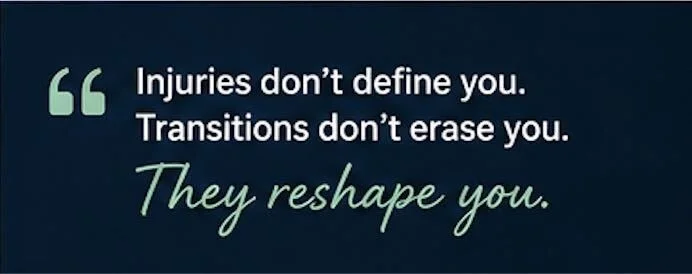
Your schedule may look different. Your responsibilities may be heavier. Your body may demand more respect. But athletic identity doesn’t come from circumstance. It comes from choice. Injuries don’t define you. Transitions don’t erase you. They reshape you.
And the athlete who learns to adapt, rather than resist, often ends up stronger than the one who only knew how to push. You don’t have to stop being an athlete. You may simply need to redefine what being an athlete means.
Ready to Build an Athletic Identity That Lasts?
At Trifecta Therapeutics, we don’t just treat injuries. We help athletes navigate rehab, life transitions, and long-term movement without losing who they are in the process. If you’re dealing with recurring injuries, post-college identity shifts, overtraining cycles, or feeling disconnected from your body, we’re here to help.
Schedule a consultation and let’s build something sustainable, together.
Written by Dr. Cale Walker, PT, DPT, OCS, CSCS, Cert. DN, BRM
References
1. Liu S, Noh YE, Kim J. Athletic identity and sport injury: a systematic review and meta-aggregation. BMC Psychology. 2026;14:111. doi:10.1186/s40359-025-03902-7.
2.The Athletic Identity Measurement Scale: A Systematic Review with Meta-Analysis from 1993 to 2021. European Journal of Investigation in Health, Psychology and Education. 2022;12(9):1214-1233. doi:10.3390/ejihpe12090097.
3. Brewer BW, Petitpas AJ. Athletic identity foreclosure. Current Opinion in Psychology. 2017;16:118-122.
4.Athletic identity and injury-related behaviors in young athletes: a scoping review. Journal of Athletic Training. 2021.
5. Brewer BW, Cornelius AE, Stephan Y, Van Raalte JL. Self-Protective Changes in Athletic Identity Following Anterior Cruciate Ligament Reconstruction. Psychology of Sport and Exercise. 2010;11(1):1-5. doi:10.1016/j.psychsport.2009.09.005.
6. Brewer BW, Shinnick R, Cornelius AE, Van Raalte JL, Badiei F. Patterns of Change in Athletic Identity After Anterior Cruciate Ligament Reconstruction. International Journal of Environmental Research and Public Health. 2025;22(1):76.